
Canada’s health workforce is evolving alongside rising care needs, demographic shifts, and rapid advancements in technology. While these pressures are significant, they also create space for new ideas and collaborative problem‑solving.
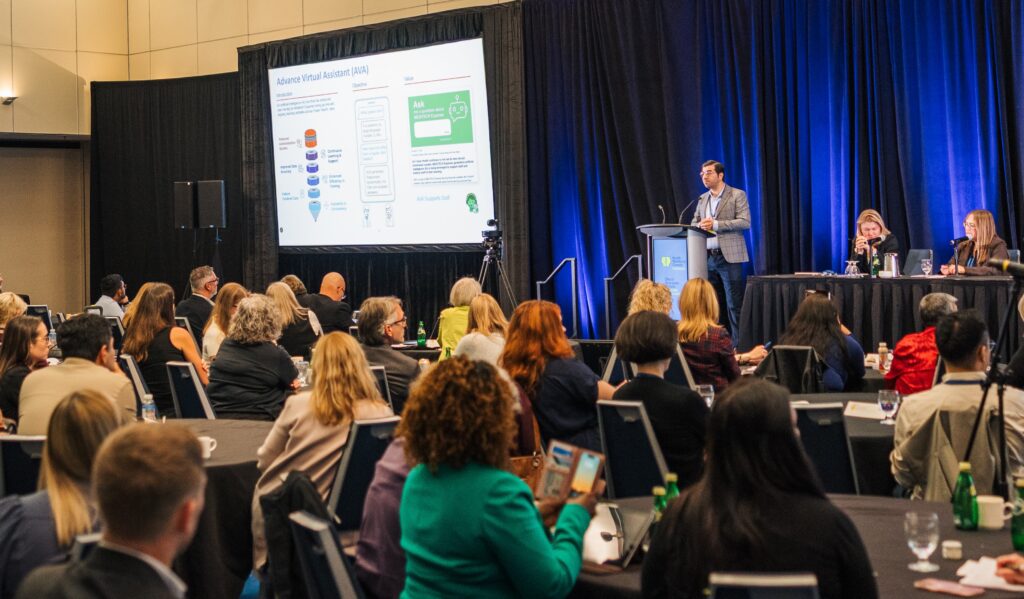
That momentum shaped the closing session at Health Workforce Canada Connects 2025, where participants came together with a shared commitment: to explore how Artificial Intelligence (AI) can strengthen the people and systems at the heart of health care.
Seeing Possibility Through an International Lens
The session opened with a keynote from Janette Hughes, Director of Planning and Performance at Scotland’s Digital Health and Care Innovation Centre. Speaking from a country with strong parallels to Canada – including rural realities, public health systems, and workforce pressures – Hughes framed AI as a necessary and inevitable part of modern healthcare. But she emphasized that its success depends on trust, ethics, and inclusion.
The session opened with a keynote from Janette Hughes, Director of Planning and Performance at Scotland’s Digital Health and Care Innovation Centre. Speaking from a country with strong parallels to Canada – including rural realities, public health systems, and workforce pressures – Hughes framed AI as a necessary and inevitable part of modern healthcare. But she emphasized that its success depends on trust, ethics, and inclusion.
Her message was clear:

Meaningful transformation requires rethinking workflows, investing in digital skills, being deliberate about equity, and engaging the workforce from the very beginning.
Hughes shared practical examples of how Scotland is already using AI to improve prevention, streamline decision-making, and support earlier interventions – from remote COPD monitoring to evidence-based decision support tools and AI-assisted breast cancer screening. These initiatives demonstrated not only technological innovation, but tangible benefits for both patients and providers, including reduced hospital admissions, shorter lengths of stay, improved safety, and strengthened clinical confidence.
A consistent theme emerged across the cases: AI succeeds only when people are at the centre of the design and decision-making.
Canadian Voices, Canadian Realities
Following the international keynote, a panel of experts grounded the discussion in the realities of Canada’s health systems.
Dr. Elizabeth Borycki, Professor and Director at the University of Victoria’s Global Lab for Digital Health and AI Innovation, highlighted the growing need for digital competencies across health care professions.
With more than 1.8 million Canadians working in health care, she emphasized that AI adoption depends as much on educators and health informatics professionals as it does on clinicians. Today’s students are learning AI-enabled tools in the classroom, and tomorrow’s workforce will expect them at the bedside. At the same time, the existing workforce requires upskilling, clear guidance, and support to critically evaluate AI outputs, engage patients in conversations about digital tools, and navigate the ethical and safety considerations of emerging technologies.
Her insights reinforced a key message: successful AI integration requires sustained investment not only in technology, but in people – including curriculum, training, and the educators who shape practice.
Next, Dr. Hamidreza Eslami, an AI development leader at Fraser Health, focused the conversation on bridging theory to frontline implementation.
He described what it truly takes to make AI work in a complex system – and the misconception that success begins with data scientists. Instead, he emphasized the importance of an integrated AI ecosystem approach, describing a foundation of interdependent components necessary for AI to work in health care: infrastructure, people, professions, governance, partnerships and trust.
He shared two successes that: were built collaboratively, tested rigorously, and implemented thoughtfully:
- Predictive Discharge Tool
An AI model that analyzes real-time clinical data to predict which patients are likely to be discharged within 24 hours. It improved discharge planning, reduced length of stay, and generated significant cost savings — not by replacing clinicians, but by giving them better information sooner. - Generative AI Learning Assistant
A conversational tool built to support staff adopting a new electronic health record systems. With more than 23,000 interactions in its first 18 months, it saved time, reduced training burdens, and helped clinicians adapt more quickly to change.
The final speaker, digital health executive Sheazin Premji, shifted the focus to the leadership mindset required to guide organizations through AI transformation.
She spoke candidly about navigating ambiguity, balancing innovation with regulation, and the dualities leaders face daily – speed and safety, experimentation and risk, scarcity and opportunity.
Her reflections emphasized:
- Humility as an essential leadership quality
- Progress over perfection as a practical strategy
- People-first approaches as non-negotiable.
Premji reminded the room that technology alone doesn’t transform systems – people do. And leading AI in healthcare requires a new kind of leadership: one that is grounded, curious, collaborative, and resilient.
Bringing It All Together: A Future Built on Collaboration
Across all speakers, one message resonated clearly: AI in health workforce planning and care delivery is not about replacing people in the health workforce – it’s about enabling them.
From Scotland’s system-level innovation to Canada’s local implementations and emerging leadership practices, the session demonstrated that AI can amplify human capabilities, support more effective workforce planning, and create space for providers to do the work only they can do.
But it also reinforced that AI’s success depends on us – our willingness to question assumptions, challenge traditional models, build trust, invest in digital skills, and choose collaboration over silos.
As Janette Hughes put it, “AI is here to stay. The question is not whether we use it, but how – and how well.”