
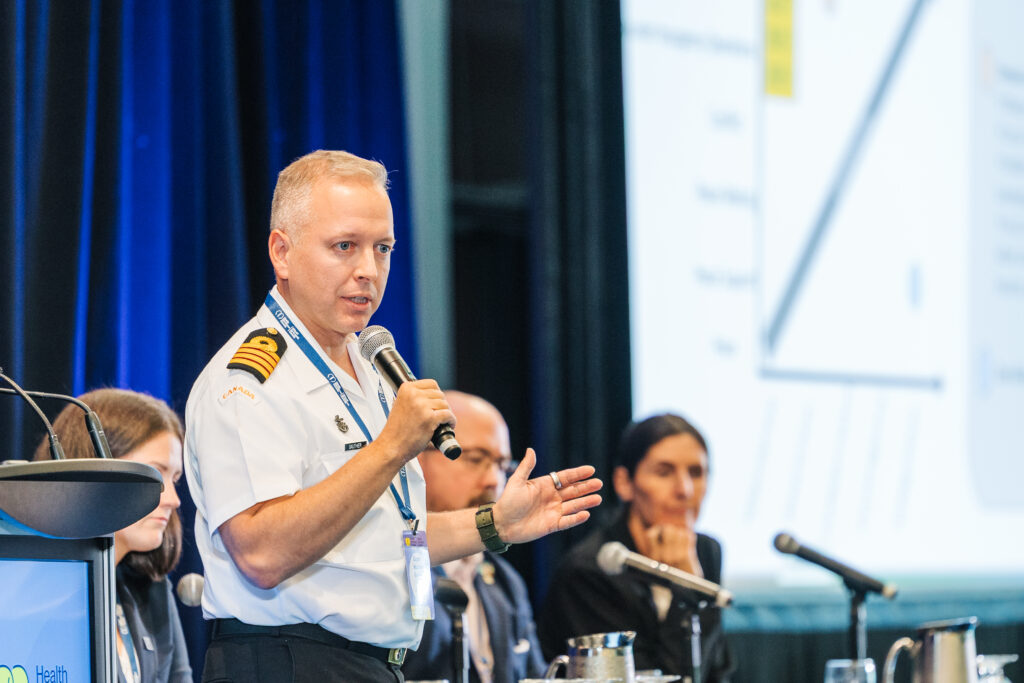
Team-based primary care is taking shape in different ways across Canada, designed to meet the needs the population it serves. At a Health Workforce Canada Connects 2025 workshop on the topic, we heard from people in different settings who were eager to share their experiences.
What we learned from speakers:
- Effective team-based care models adapt to local contexts while maintaining core principles
- Integration of interprofessional health providers improves access and system efficiency
- Virtual care extends team-based approaches to rural and remote communities, and
- Cultural integration is essential, particularly in Indigenous contexts.
Dealing with hierarchy
On power dynamics in team-based care, Captain Nick Gauthier, Director Corporate Services, Canadian Forces Health Services, Canadian Armed Forces, described leadership as situational in the Canadian Forces Health Services, with different team members taking the lead based on the situation rather than rank alone. He emphasized the importance of “followership” alongside leadership – that leaders need to know when to follow.
Shelly McLean, Director of Health Services, Lennox Island, First Nations Health Managers Association talked about their approach as similar to “family consensus” where every voice matters and decisions are made with respect. Leadership shifts based on who holds the most relevant knowledge for a given situation.
Scope of practice
Speakers talked about how to respect professional scopes while enabling collaboration and full scope practice. Dr. Josh Greggain, Director, Family Practice Residency Program, University of British Columbia, spoke from a rural generalist perspective about the need for “professional humility” to release certain aspects of care to other team members with appropriate expertise, such as midwives or physiotherapists.
Emily Stevenson, Registered Physiotherapist, Director of Practice and Policy, Ontario Physiotherapy Association viewed optimizing scope of all team members as a value-add that improves access. She emphasized the importance of communication, shared electronic medical records, and clarity about roles.
How to scale?
Scaling team-based primary care was a key topic. Josh emphasized the importance of dialogue and understanding community needs first. He described how their virtual support services grew by being responsive to emerging needs rather than following a predetermined strategic plan.
Shelly shared that culture must be the foundation, with models adapting around teachings and ceremonies. She stressed the importance of building trust, recognizing that one size doesn’t fit all, and investing in what already works well.
Indigenous approaches
Shelly described Nepisimkuo’kom (a place of healing) at Lennox Island First Nation, and how their patient medical home integrates Mi’kmaq culture, traditional medicines, and community-centered care. She noted that First Nations have always worked in team-based ways before the formal “patient medical home” concept.
Shelly said they focus on creating safe spaces for care, respecting traditional ceremonies and culture with a clan-based team structure – a connected circle supporting the whole clan, the whole community. According to Shelly, community leadership and vision drive successful implementation.
Military health system preparedness
Nick presented the Canadian Forces Health Services as the “14th health system” in Canada, describing their jurisdiction and capabilities. He emphasized the changing geopolitical situation and potential rapid escalation of healthcare resource needs.
Nick described exercises testing provincial health systems’ capacity to handle mass casualties (300 multi-trauma patients daily for 30 days) and the need for patient coordination cells at national and provincial levels. He stressed the deterrent effect of medical readiness and the importance of preparing before crises occur. According to Nick, military health system preparedness has implications for civilian systems, and patient flow management systems are critical for mass casualty response. Collaboration between military and civilian health systems is essential. Preparation must occur before crises, not during them.
Virtual care
Josh described the evolution of virtual care from early Cisco devices to Zoom-based real-time virtual support services across British Columbia. He explained how these services connect rural providers with specialists for emergency care, maternity services, and complex cases. He shared examples of supporting rural providers virtually to perform procedures like suturing, cardioversion, and delivering babies when patients couldn’t be transported.
Josh showed that technology enables “transporting in” expertise rather than transporting outpatients. At the same time, relationship-building remains essential even in virtual contexts.
Interprofessional team roles in primary care
According to Emily, 20-30% of primary care visits in Ontario are musculoskeletal. Physiotherapists in primary care teams support people across their lifespan, supporting musculoskeletal, neurological, cardiorespiratory, and metabolic conditions. In the first contact physiotherapist model, physiotherapists become the initial contact for musculoskeletal conditions, with evidence of reduced diagnostic imaging, specialist referrals, sick leave, and pharmaceutical prescriptions.
Funding
When it comes to funding, Emily highlighted the value of salaried models for interprofessional care providers in Ontario’s primary care teams, allowing providers to deliver the right amount of care based on patient needs rather than visit quotas.
Josh described BC’s Longitudinal Family Practice Model of Care, which pays physicians for patient interactions and time spent with interprofessional teams, representing a hybrid model balancing volume and interprofessionalism.
Actions
What actions can we take based on learnings from this workshop?
- Innovate funding models to support team-based primary care
- Work with universities to develop team-based care competencies
- Leverage data to inform team composition and planning
- Identify and share best practices in team-based care
- Engage in communities of practice around team-based care
- Explore opportunities to implement first contact roles for interprofessional health care providers
- Consider how to address power dynamics in existing team structures.